04/16/2013 (12 Moons Solo Project Day 106)

12 Moons Solo Saxophone Project Day 106

Date: 04/16/2013

Instrument: Tenor saxophone

Location: Home studio in Clinton, WA (Whidbey Island)

Notes:

I spent the day teaching at a music camp in South Seattle.  During a jazz improvisation workshop I found myself saying the phrase “make your statements more declarative."  This seems to be a theme for me while playing these past few years, and particularly so when it comes to my use of cyclic patterns and phrases.  The cycles themselves allow me to explore a wide swatch of color within a given framework, and it’s that idea of a "given framework,” in that I specifically give myself boundaries from which to begin my exploration.  Today I decided to use specific multiphonics that have a very sine wave sound to them.  There’s a tightness to the chord, and when I trill one like mulitphonic against another the motion is noticeable but still very slight. 

With the multiphonics used in this improvisation, I approached the piece as though I were playing a chorale with ornamental trills.  The slight variation from one chord to another has its own kind of repetitive movement, and after listening for some time the chords began to sound very tonal to me.  I based this piece off of the following fingering:

(Left Hand) B-A keys, Low Bb // (Right Hand) F-E keys, Low C, High F)  

To create the other chords, the A key is lifted in the left hand or the Fork F key is added in the left.  At other times the right hand F key is opened and closed.  The dramatic shifts in volume during the piece use the same root fingering above, which then carried a sustained middle octave Concert C (quarter step high).  The upper register tones that were added to the Concert C were drawn from the multiphonic chords, which reappear in their fullness once again when played at high volume.

-Neil

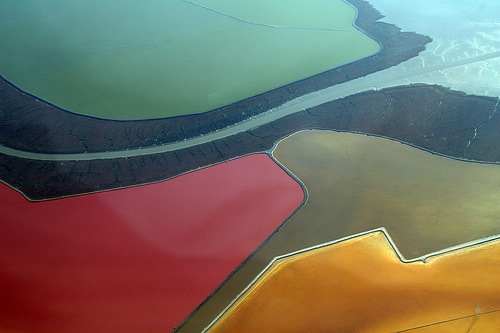
The image “Organization” accompanying today’s post by painter Arshile Gorky

04/15/2013 (12 Moons Solo Project Day 105)

12 Moons Solo Saxophone Project Day 105

Date: 04/15/2013

Instrument: Tenor saxophone

Location: Home studio in Clinton, WA (Whidbey Island)

Notes:

My improvisation today explores melodicism within both chordal gestures and in single pitches.  The approach taken in this piece is somewhat different than any I’ve explored within this solo project so far.   Generally, when I thread chords together it’s the chords themselves that are the main focus, but today I instead worked to place the internal pitches in the forefront of the sound field.  This was partially achieved because of the fingering system used.  During this improvisation the high F# key is constantly trilled, and when this particular key is trilled against virtually any other fingered pitch, the same high tone will be produced.  This is less common in other trilled fingerings, where the trilled note will not speak in particular octaves or when paired with certain notes.

I broke the horn into three centers of action during this piece.  Action 1 is the opening gesture, where the upper octave tone is trilled and there is a middle octave Concert F to Gb moving back and forth.  This uses the following fingering:  (Left Hand) B-A-G keys // (Right Hand) F key, Low C, High F.  The High F# key is constantly trilled in the right hand and the Low Bb at a slightly slower tempo in the left.  

Action 2 takes place in the upper register, which centers on a chromatic gesture moving from Concert Bb to G.  I used traditional fingerings here and continued to trill the High F# key.  Later in the improvisation I begin to break away from the stringency of pure chromaticism and eventually add other melodies that have larger intervals. Though it sounds much more busy than the lower register Action 1, there are only fleeting moments of harmony in this section.  The bulk of it is composed of single note to note melodies moving at a fast tempo.   

Action 3 is a static, middle register flutter, which I used more to create an essence of space in the piece rather than as a new section unto itself.

-Neil

The image “Door to the River” by painter William De Kooning (1960).

04/14/2013 (12 Moons Solo Project Day 104)

12 Moons Solo Project Day 104

Date: 04/14/2013

Instrument: Tenor saxophone

Location: Rec Room of my family home. Edmonds, WA

Notes:

A specific region of the horn I’m exploring lately is the lower right hand stack clutch key.  When the notes F, E, D and F# are played this secondary clutch key is depressed, but there is no traditional fingering that allows it to close on its own.  The discoveries I’ve made so far are limited in application, because the key has more of a complimentary effect when put against other pitches rather than any jarring change–at least through what I’ve uncovered so far.  My improvisation today makes use of this key to create fluttering tones that combine with embouchure techniques to explore mid and upper range tones.   

I recorded this improvisation at a medium volume, trying to incorporate the key tones from the body of the horn as much as the played pitches themselves.  There is a static upper register Concert Eb to D that is created by trilling the clutch key with my right hand, and using the following fingering: 

(Left Hand) Fork F, A, G keys (Right Hand) trill the lower stack clutch key.  I also continuously trill the G key in the right hand, though at a much slower tempo than the trill maintained in the right.

My aim during this piece was to create a static universe with the continuous gesture, and to explore the upper tones at will.  About 2/3 through the improvisation there is an abrupt drop in octave and pitches.  This was done with my embouchure and not through any change in the fingering system.  I drop down once again near the end of the piece, though this time I worked to incorporate tones from the mid register as well.

-Neil

04/13/2013 (12 Moons Solo Project Day 103)

12 Moons Solo Saxophone Project Day 103

Date: 04/13/2013

Instrument: Tenor saxophone

Location: Home studio in Clinton, WA

Notes:

Variation in tempo became a quick theme in my practice session today.  My 12 Moons project so far has focused heavily on multiphonics and other clustered tones, and I intentionally pushed for variation today.  In the duo Bad Luck, drummer Chris Icasiano and myself work on malleable time, where tempos can fluctuate smoothly or abruptly, but we have learned to respond to one another so well that the transitions feel very natural when doing them together.  Individually, today I decided to work with the abrupt sense of malleable time.  Instead of finding rhythmic subdivisions, I broke my freely performed melodies down into a tempo spectrum from slow to fast.

While practicing I began by arbitrarily moving from one tempo to another without an pre scripted number of notes within a given tempo.  I then decided to zone in on specific numbers of pitches, and began to get a sense of my control over different tempos.  I seemed to most easily hear the differences between slow, med slow, med, med fast, and fast.  When I tried to break these cycles down once again, for example adding a new tempo between slow and med slow, it became much more difficult to hear them in the moment.  When putting one against another it’s easier for me to execute than if, for instance in the moment I tried to move from “fast” to “med slow” to “between med slow and slow."  This was really enlightening for me, because if I was only limited to hearing "slow, med slow, med, med fast and fast,” this is the equivalent to only being able to hear the dynamics “pp, mp, p, mf, f,” which would limit the total spectrum so much.  This is ablsulutely something for me to work on in the future.

None the less, after performing this improvisation I did not meet my goal of having only 5 tempos, because at times I did explore a few more in between.  I account for this in that during the improvisation I would at times cluster tempos together, where I might explore the slower version of the spectrum versus the faster.  This naturally made me inclined to dig into the tempo variations a little deeper to find new ones in between.  However, I noticed that when moving between, for example fast to med slow, I tended to then move somewhere more predictable, say med fast, versus somewhere between fast and med fast.  I broke the melodies in this improvisation down into groupings of 8, 6, and 4, giving approximately equal time to each.

-Neil

04/12/2013 (12 Moons Solo Project Day 102)

12 Moons Solo Saxophone Project Day 102

Date: 04/12/2013

Instrument: Tenor saxophone

Location: Home studio in Clinton, WA (Whidbey Island)

Notes:

My practice session today centered around cyclic patters with a consistent rhythm and fingering system that broke off into different sound-scapes.  In this improvisation the rhythmic cycle is 1 2 3 4 5 (rest).  It could also be interpreted by a listener as 1 e & a 2 (rest), though in the moment I thought of it as the former.  My goal was to freely explore different rhythmic, harmonic and melodic cycles that would emerge by changing my embouchure and air flow rather than changing fingering systems.  I tried to maintain a steady tempo, but there is a gradual slowing from start to finish in the piece that was unintentional. 

The fingering cycle was as follows: 

1.  (Left Hand) B-A-G keys, Octave, Low B // (Right Hand) E-D keys, High F#

2.  (Left Hand) B-A-G keys, Octave, Low B // (Right Hand) E-D keys (take away the High F#)

3.  (Left Hand) B-G keys, Octave, Low B // (Right Hand) E-D keys

4.  (Left Hand) B-A-G keys, Octave, Low B // (Right Hand) E-D keys (add back the A key)

5.  (Left Hand) B-A-G keys, Octave, Low B // (Right Hand) E-D keys, High F#

I focused on creating a variety of color at different levels of volume and mouth pressure.  It’s also of note to say that I tried to free my mind of the rhythm cycle I was playing in.  Since it was static, I instead tried to focus on the polyrhythms  and melodic counterpoint within the sound-scapes.

-Neil